The Weight of Distance considers what remains between places that history has connected, separated and continually brought back into relation. Across the Atlantic, histories of colonialism, displacement and migration have produced enduring networks of cultural exchange, memory and belonging. Yet these histories are not evenly remembered. The dominance of Anglophone accounts of African colonialism has often left the particular histories and afterlives of Portuguese colonialism less visible. This exhibition brings the Anglophone and Lusophone worlds into the same field of enquiry, tracing connections between Africa, Portugal and Brazil and asking what becomes possible when these histories are understood in relation to one another.
The exhibition takes Atlantic continuity as a point of departure: not a seamless connection across the ocean, but the persistence of relationships that have survived rupture. People, beliefs, images, languages and systems of knowledge have crossed the Atlantic through conditions of coercion, migration and exchange. In the process, they have been transformed. What arrives is never quite what is left. Cultural knowledge is carried, adapted, fragmented and reconstituted, producing new forms of identity and belonging across generations.
Contemporary art offers a particularly generative space through which to encounter these histories. The artists brought together in The Weight of Distance do not approach the past as a fixed archive. They work through its fragments, absences and inheritances, drawing on ancestral memory, spirituality, landscape, the body, photography, ceramics and other material and visual languages to ask how histories continue to inhabit the present. Their practices reveal memory as something active: continually reconstructed through lived experience, cultural transmission and the negotiation of place.
The relationship between Africa and Brazil is central to this inquiry. The histories produced through the transatlantic slave trade cannot be separated from the cultural worlds that emerged in its aftermath. African cosmologies, forms of knowledge and systems of belief were carried across the ocean and transformed within diasporic contexts. The resulting cultures are not simply remnants of what was left behind, but complex forms of continuity and reinvention. This relationship between inheritance and transformation offers a way of understanding how cultural identities persist across displacement, while also acquiring new meanings within the places to which they travel.
The works gathered here consequently resist the idea of distance as absence. Distance can fracture relationships, but it can also produce new forms of connection. It is measured not only in geography, but in the gaps between generations, languages, histories and cultural memories. What does it mean to inherit a history from a place one may never have known? How does a culture remain present when it has been displaced, suppressed or transformed? And what forms of knowledge persist when they exist outside official historical narratives?
These questions unfold through two interconnected movements: Atlantic Continuities and Making Home. The first attends to the circulation and transformation of memory, cosmology, identity and cultural knowledge across the Atlantic. The second turns towards the question of belonging: how home is remembered, reconstructed and inhabited through migration, inheritance and lived experience. The two are inseparable. To move across distance is also to renegotiate one's relationship to place.
The Weight of Distance does not attempt to produce a singular history of the Atlantic. Instead, it creates a space in which different histories can encounter one another, particularly those shaped by Portuguese colonial formations and their divergent yet interconnected legacies. By placing African and diasporic practices within a broader Anglophone-Lusophone conversation, the exhibition seeks to make visible connections that have too often remained apart.
Presented through Latitudes Online as part of the RMB Latitudes CuratorLab, the exhibition uses the digital space to bring geographically dispersed practices into proximity. Here, distance becomes both subject and method: the separation between places becomes a way of thinking about what connects them. Across the works, the Atlantic emerges not as a boundary between continents, but as a space of passage, rupture, inheritance and transformation, a space in which histories continue to travel, and where the weight of what has been carried remains present.
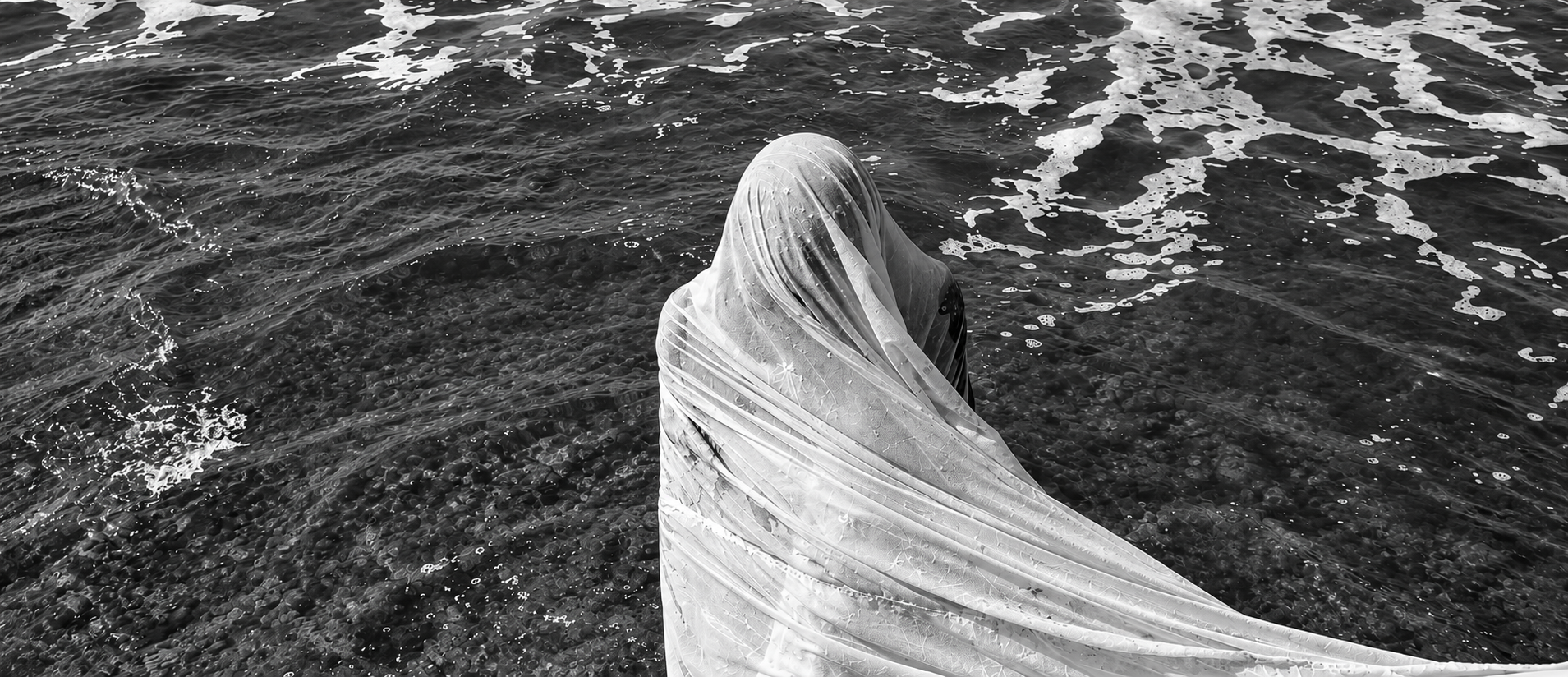
Image Credits: Mario Macilau, ‘Faith Series’, Untitled #5, (2026)
For enquiries or press kits please contact: timikasukhai@gmail.com